Monday, June 3, 2013

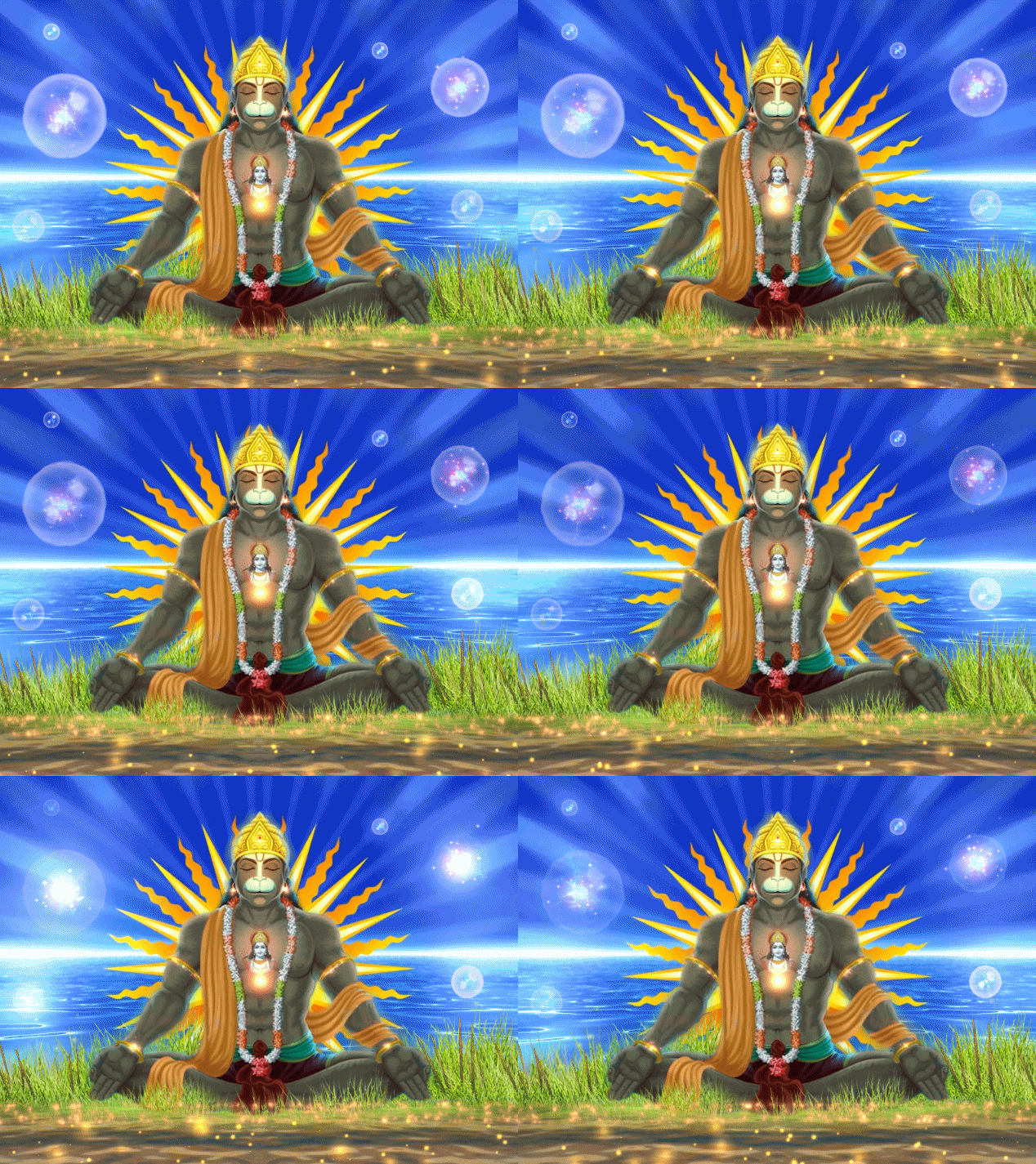
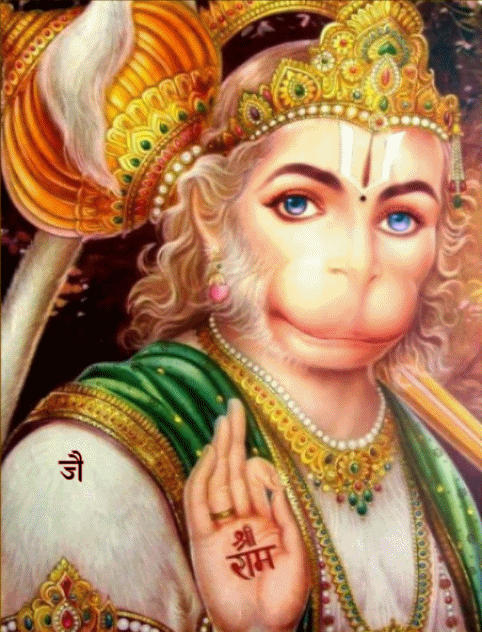
“HANUMAT KALYANAM”


Never knew that Lord Hanuman was married. Rare picture – at least for me! Jai Hanuman!

The boons granted by the gods made Hanuman invincible.

The monkey child became uncontrollable.

He became very mischievous.

His pranks irritated many.

He did not spare the sages even.

He would pounce on them and tear their dress.

He would throw fruit and leaves, perched atop trees.

They bore with him patiently being aware of his future.

One day a sage was very much disturbed by Hanumantha.

The sage went into a rage and cursed Hanumantha:

“ May you forget your strength with which you have caused us so much of pain”. 


The curse changed the life of Hanuman altogether.

He became very calm and inert.

The change pained the sages.

They altered the curse on him.

They blessed him thus:

  “If any one reminds you of your strength, you would recognize your 
strength and abilities and succeed”.

This boon chastened Hanumantha.

He became a well-behaved child and an epitome of virtuousness.

Hanuman was growing older.

His mother told him:

“Son! It is time to get educated. There is no better teacher than Surya, the Sun god, who dispels all darkness. Go to him and gain knowledge.”

Even though he was omnipotent, Hanuman obeyed his mother.

He reached the Surya Mandala and humbly prayed the Sun god:

“O! Surya Deva, I want to learn Vedas, Vedangas, and Upangas from you. Please teach me.” Surya replied:
“O! Boy of Anjana, I am always on the move, as ordained by Almighty, how can I teach you? ”

Hanuman was angered.
He blocked the path of Surya.
Surya pacified Hanuman.

He said: “I have no objection to teach you. But you have to find a way to learn”.

Hanuman stood facing the sun and started walking backwards.

Surya was moving forward and was teaching Hanuman.

Lord Siva is said to know all and Hanuman, who is Lord Siva’s incarnation, proved to be one who knows all as well.

With in a week of his education, he astonished Surya.

Surya praised Hanuman.

 Hanuman wanted to continue his education.

Instead of walking backward, he put one foot on the rising hill and the other one on the setting hill to face the Sun god.

Hanuman’s interest and devotion pleased the Sun god.

Surya taught all that is to be taught to Hanuman.

Surya was married to Sanjana, a daughter of Viswakarma.

Sanjana was devoted wife but was unable to bear the heat emanating from the Sun’s rays.

She was suffering with anguish.

Her mother noticed the daughter’s plight and sought to know as to what the problem was.

Sanjana explained her problem to her mother.

Her mother in turn told Viswakarma of Sanjana’s problem.

Viswakarma told Surya that he would polish off some of the luminescence of Surya.

Surya agreed. Viswakarma was able to polish off some luminescence of his son-in-law.

The luminescence thus separated took the form of young woman.

Her beauty and grace astonished even gods.

Indra wanted to know as to who would marry that shinning brilliant young women.

Brahma thought for a while and replied: “Hanuman who is essence of Lord Siva’s fiery power will marry the young woman. Since Hanuman tried to grab the ever glowing Sun god, he alone can bear this glowing young woman”.

Surya remembered Brahma’s utterance.

By than Hanuman’s education was complete.

He was ready to graduate.

He bowed to Lord Surya and said: “O! My divine teacher! Thanks to you I am educated now. I would like to take your leave now. I would like to offer you an appropriate fee as Guru Dakshina. Kindly order me”.
Surya immediately replied:
“O Hanuman, you are the incarnation of Lord Siva who bore the poisonous HAALAAHALA to save the universe when the ocean was churned. You are also son of Agni, the fire god. Viswakarma separated a part of my luminescence and the world is unable to bear it. You are the only one who can bear it. So I want to offer you my daughter Suvarchala formed from my ‘VARCHAS’ (luminescence), in marriage. Marry my daughter. Since husband is the one who is to bear, you also bear my ‘Suvarchas’ by marrying Suvarchala. Your marrying her shall be my Guru Dakshina”.

Hanuman listened to his teacher and replied politely:
 “O Lord! I have decided to follow Brahmacharya throughout my life. 
How can I marry?”

Surya replied:
“O Hanuman, this Suvarchala is a divine one, Ayonija. She would be a devoted wife. I am giving you the boon that you would still be a Brahmachari even after marriage. You would continue to be a Prajapatya Brahmachari. Your marriage is only for the welfare of the Universe and it would not affect your chosen course of celibacy. You were a born Brahmachari with a Yajnopavita (Sacred thread). Brahmacharya will be your eternal pursuit. Since you are going to be a Brahma in future, Suvarchala will then occupy the place of Vani”.

Hanuman obeyed his preceptor’s advice.
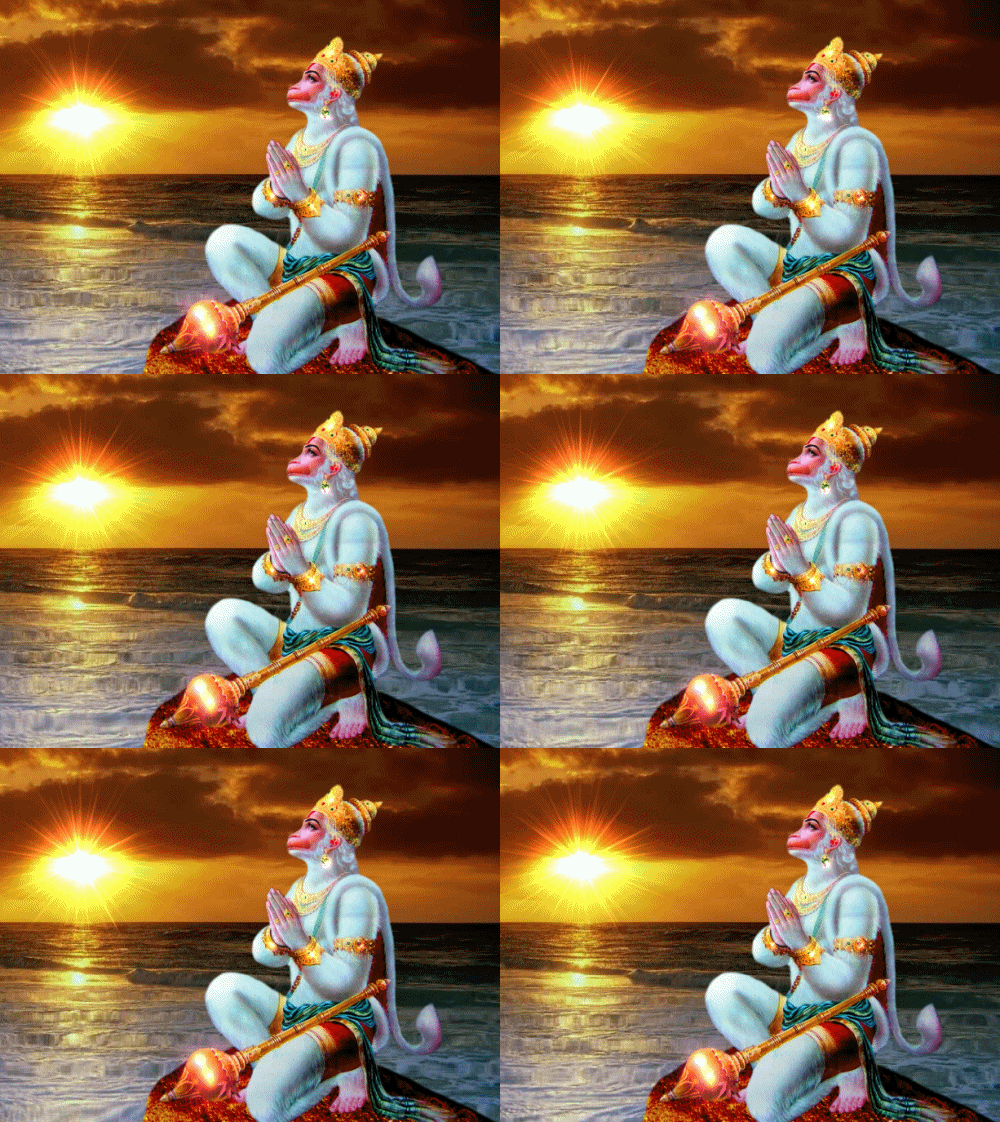
Surya presented Suvarchala to Hanuman.
It is stated in PARASARA SAMHITA, that Surya offered his daughter Suvarchala in marriage on JYESTHA SUDDHA DASAMI.
It was a Wednesday under the star UTTARA.
Those who respect tradition, even to this day, observe “HANUMAT KALYANAM” 
(Hanuman’s Marriage) on JYESTHA SUDDHA DASAMI day.

— with Sai Sathisvaran Rajoo Vahyuputhran and Hima Sudha Gummadi.


Friday, January 18, 2013

Indians migrated to Australia


Indian genes had got mixed with that of Australian aboriginals more than 4,000 years ago — centuries before the Europeans colonized Down Under.

Dingo, the Australian wild dog, may have also been an Indian export besides stone tool technologies that changed the way Australian aboriginals lives their lives.
Latest scientific evidence published on Tuesday has found that Australian aboriginal and Indian genes were mixed.

A study by researchers of the Max Planck Institute for Evolutionary Anthropology in Leipzig, Germany, has now confirmed evidence ofsubstantial gene flow between Indian population and Australia aboriginals about 4,000 years ago.

Interestingly, the study also suggests that this migration coincided with several changes in the archaeological record of Australia, which include a sudden change in plant processing and stone tool technologies, with microliths appearing for the first time, and the first appearance of the dingo in the fossil record.

Speaking to TOI from Germany, lead researcher Irina Pugach said, "Since we detect inflow of genes from India into Australia at around the same time, it is likely that these changes were related to this migration."

She explained, "We have estimated the amount of Indian contribution to Australian genomes at around 10%, but this number doesn't tell us anything about how many individuals might have migrated. This number depends on the size of the Australian population at the time, and we don't know how big it was. The amount of Indian ancestry could have become inflated through the process known as genetic drift, especially if the Australian population was small."

"Out of the populations considered in the study, Dravidian-speaking groups are the best match to be the source populations for this migration, but this does not mean the ancestors of these groups actually were the source population. It is possible, that there is another group which we didn't sample yet. Another possibility is that this group doesn't even exist anymore," she added.

Australia holds some of the earliest archaeological evidence for the presence of modern humans outside Africa, with the earliest sites dated to at least 45,000 years ago, making Australian aboriginals one of the oldest continuous populations outside Africa.

Now, researchers have analyzed genetic variation from across the genome from aboriginal Australians, New Guineans, island south-east Asians and Indians.

Dr Pugach said, "Our findings suggest substantial gene flow from India to Australia 4,230 years ago — during the Holocene and well before European contact. Currently the accepted view is that Australia has been completely isolated for almost 45 thousand years following its initial colonization in the late 1800s. Yet Australian archaeological record documents some changes which occur in Australia around — 4,000 years ago, which could have been potentially brought in from the outside."

"In principle, mid-Holocene is a period of expansion in trade interactions in the region of greater Australia, and some suspected Island Southeast Asia as a potential source of the observed cultural shift in Australia. Some previous genetic studies also hinted at possibility of gene flow from India. The significance of our work is that we examined this question with much more genetic data and were able to firmly establish a signal of gene flow from India to Australia. We were also able to date this gene flow to 4,000 years ago," she added.

The study said that though the DNA of dingoes appears to have a south-east Asian origin, "morphologically," the dingo most closely resembles Indian dogs.

It cited genetic and archaeological evidence to suggest that anatomically modern humans expanded from Africa and colonized all corners of the world, replacing with limited gene flow local archaic Homo populations. The expansion of modern humans apparently proceeded via two routes: the northern dispersal that gave rise to modern Asians 23,000-38,000 years ago and an earlier southern dispersal, which followed the coast around the Arabian Peninsula and India to the Australian continent. It has been suggested that the ancestors of aboriginal Australians diverged from the ancestral Eurasian population 62,000-75,000 years ago and, based on archaeological evidence, reached Sahul — the joint Australia-New Guinea landmass — by at least 45,000 years ago.

The prevailing view is that until the arrival of the Europeans in the late 18th century, there was little, if any, contact between Australia and the rest of the world although some chromosomal studies suggested some gene flow to Australia from the Indian sub-continent during the Holocene (around 12,000 to 11,500 years ago).

"Here, we analyze genome data and find a significant signature of gene flow from India to Australia, which we date to about 4,230 years ago," the study said.


Monday, January 7, 2013

Solar Charger Tree


Solar Charger Tree Feeds Gadgets with the Fruit of Electricity
The charger has a built in 3,000mAh battery that can be charged either via the leaf-like solar panels or via AC power. It comes with a variety of connectors for all sorts of mobile devices, including Samsung, Apple, Nokia and micro USB.
it’s main advantage is it’s way cheaper.


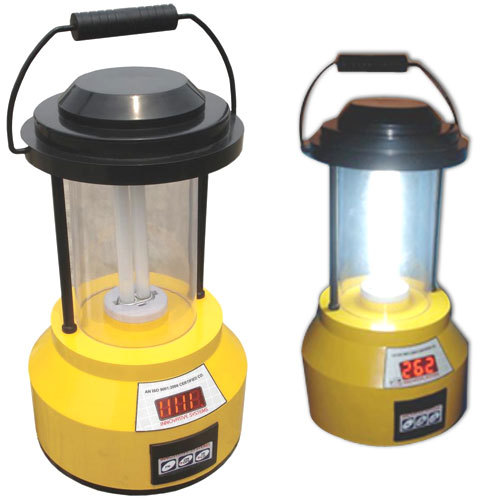
Emergency Light

Monday, December 31, 2012

Happy New Year 2013!


May this New Year be an adventurous journey for you to explore new avenues and reach heights of success.


May the new year that follows be the best you have ever had. Have a blissful new year!

May you celebrate and enjoy the simple pleasures of life in the coming year.  Happy New Year 2013!
Happy New Year 2013 Love Card.
Wishing you good health, happiness, and success in the coming year and always.  Happy New Year!

May you have new hopes, aspirations, and resolutions for the coming year. Have a happy new year!

Friday, June 1, 2012

a BIG change in YOU

Read this small story; Hope that makes a BIG change in YOU
-------------------------------------------------------------------------
The Professor began his class by holding up a glass with some water in it. He held it up for all to see & asked the students “How much do you think this glass weighs?”


’50gms!’….. ’100gms!’ …..’125gms’ …the students answered.
“I really don’t know unless I weigh it,” said the professor, “but, my question is:
What would happen if I held it up like this for a few minutes?”
‘Nothing’ …..the students said.
‘Ok what would happen if I held it up like this for an hour?’ the professor asked.
‘Your arm would begin to ache’ said one of the student
“You’re right, now what would happen if I held it for a day?”
“Your arm could go numb; you might have severe muscle stress & paralysis & have to go to hospital for sure!”
….. Ventured another student & all the students laughed
“Very good.
But during all this, did the weight of the glass change?” Asked the professor.
‘No’…. Was the answer.
“Then what caused the arm ache & the muscle stress?”
The students were puzzled.
“What should I do now to come out of pain?” asked professor again.
“Put the glass down!” said one of the students
“Exactly!” said the professor.
Life’s problems are something like this.
Hold it for a few minutes in your head & they seem OK.
Think of them for a long time & they begin to ache.
Hold it even longer & they begin to paralyze you. You will not be able to do anything.

It’s important to think of the challenges or problems in your life, But EVEN MORE IMPORTANT is to ‘PUT THEM DOWN’ at the end of every day before you go to sleep…
That way, you are not stressed, you wake up every day fresh &strong & can handle any issue, any challenge that comes your way!

So, when you start your day today, Remember friend to ‘PUT THE GLASS DOWN TODAY! ‘

Wednesday, May 9, 2012

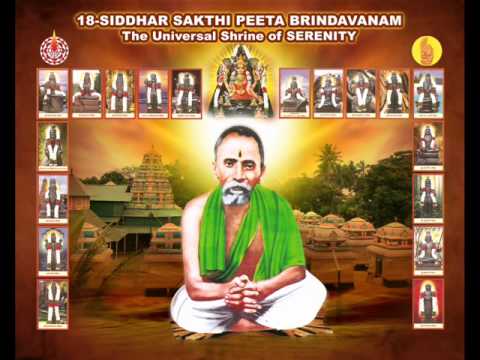
Sri Maha Meru 18-Siddhar Sakti Peetam,


THE WORK on the Sri Maha Meru 18-Siddhar Sakti Peetam,  at Madambakkam near Chennai, is over and the shrine  It was the wish of Sri Seshadri Swamigal of Tiruvannamalai to have a single Sakti Peetam for Sakti and the 18 siddhars.
The Seshadri Brindavanam Trust, at Madambakkam near Selaiyur, Tambaram.
A unique aspect of the Peetam is that the Mahameru shrine has been carved out of a single green granite stone. The 135-cm Mahameru has been sculpted according to the norms laid down by Adi Sankara. The Mother Goddess is flanked by Sri Seshadri Swamigal on one side and Sri Guruvayur Krishna on the other. There are shrines for Sri Maha Ganapathy, Sri Subramanya with His Consorts, Sri Muniswarar, Sri Rajakali Amman, Sri Kamadenu, the four Saiva saints and Sri Nandikeswarar.

There is no separate place of worship for the navagrahas since the Siddhars are believed to reflect their powers as well. Also there are shrines for Sri Nagaraja as found in the temple of Tirunageswaram, Sri Kodhandaramar and Sri Anjaneya. 
The Trust has been conducting free health camps, Annadanam, and distribution of milk for children on Sundays. Plans for the future include an old age home, free medical aid for the poor and a Siddha medical research centre.

Saturday, April 28, 2012

10 Strange & Unusual Facts About Australia


10 Strange & Unusual Facts About Australia

Australia today is a vibrant multicultural country with people of British descent, as well as Aboriginal and immigrants from many countries in Europe, Africa and Asia. It is the sixth largest country in the world and the only country that is also a continent. Australia is in the Southern Hemisphere, where Summer is from December to February. Here are some more interesting things that you may not know about Australia.

01. Dingo Fence - The World's Longest Fence
Dingo Fence on the 29th parallel of latitude. Sturt National Park (right of fence) - looking east from Cameron Corner after rain.
02. The Flying Doctor
The Royal Flying Doctor Service of Australia (The Flying Doctor) is an emergency and primary health care service for those living in rural, remote and regional areas of Australia. It is a not-for-profit organisation which provides health care to people who are unable to access a hospital or general practice due to the vast distances of the Outback. The Royal Flying Doctor Service is a unique icon of Australian culture.

03. Home to 100 Million Sheep's
At the turn of the new century (2000), there were estimated to be 120 million sheep in Australia. Due to the effects of ongoing drought and lower demand for wool due to the wool stockpile, this figure has gradually fallen to the point where there is currently an estimated 100 million sheep in Australia.  Therefore, Australia has five times more sheep than people (20 million inhabitants).

04. Why Canberra is the Capital of Australia?
The site of Canberra was selected for the location of the nation's capital in 1908 as a compromise between rivals Sydney and Melbourne, Australia's two largest cities. A location was chosen which was 248km (154mi) from Sydney and 483km (300mi) from Melbourne. It is unusual among Australian cities, being an entirely planned city.

05. Largest Cattle Station in the World
The Anna Creek cattle station in the South Australian Outback is by far the largest working cattle station (ranch) in the world. It covers a huge area of some 34.000 sq km (13,000 sq mi). This makes the station bigger than the country of Belgium. By comparison, the largest ranch in the USA is around 6,000 square kilometres. The ranch has a carrying capacity of 16,000 head of cattle but due to the extended drought in Australia this has currently been reduced to less than 2,000 head.

06. Australian Alps Receive More Snow Than Switzerland
Every winter the Australian Alps have more snow cover than Switzerland. The Alps (or "Snowy Mountains") are part of the Great Dividing Range on the eastern side of the country. The Great Dividing Range stretches over 3.500 kilometers (2,200 mi) and runs from north to south through the states of Queensland, New South Wales and Victoria. The snowfields are an important feature for Australian tourism. When it's summer in the northen hemisphere, it's winter in Australia. The snowfields are an important part of the local tourism industry. Thousands of visitors from the Northen Hemisphere come to enjoy the skiing and other winter activites on the Aussie snowfields.

07. Largest Organic Construction on Earth
Great Barrier Reef is the largest coral reef in the world, also, it is the largest organic construction on Earth. It stretches for 1,250 mi (2,000 km) in the Coral Sea, off the coast of Queensland, Australia. The Great Barrier Reef is actually a series of individual reefs separated from the mainland by a shallow lagoon. The reef is extremely beautiful and attracts thousand of tourists a year, which threatens to harm the delicate eco-system of the reef and its unusual marine life.

08. Sydney’s Opera House
The Sydney Opera House is a modern expressionist design, with a series of large precast concrete "shells", each composed of sections of a sphere of 75.2 metres (246 ft 8.6 in) radius, forming the roofs of the structure, set on a monumental podium. The building covers 1.8 hectares (4.4 acres) of land and is 183 m (600 ft) long and 120 m (394 ft) wide at its widest point. It is supported on 588 concrete piers sunk as much as 25 m (82 ft) below sea level. Sydney’s Opera House was designed in 1957 by Jorn Utzon, a Danish architect. Its roof weighs more than 161,000 tons.

09. Australia Was Home to 160,000 Prisoners
Britain discovered Australia and as a result used it as a place of imprisonment for thousands of convicts and political prisoners. About 160,000 of Britain's unwanted were shipped out there. Many died on the high seas during the eight month journey. Now, about twenty five percent of Australians have ancestors who were convicts.

10. Australian Antarctic Territory
The Australian Antarctic Territory (AAT) is a part of Antarctica. It was claimed by the United Kingdom and placed under the authority of the Commonwealth of Australia in 1933. It is the largest territory of Antarctica claimed by any nation. The Australian Antarctic Territory covering an area of almost 5,9 million sq km (2.3 sq mi) is the largest of these territories.